The Courage to Fly: What Bakasana and other Balance Poses Teach Us About Trust
There is a particular moment in Crow Pose when something changes.
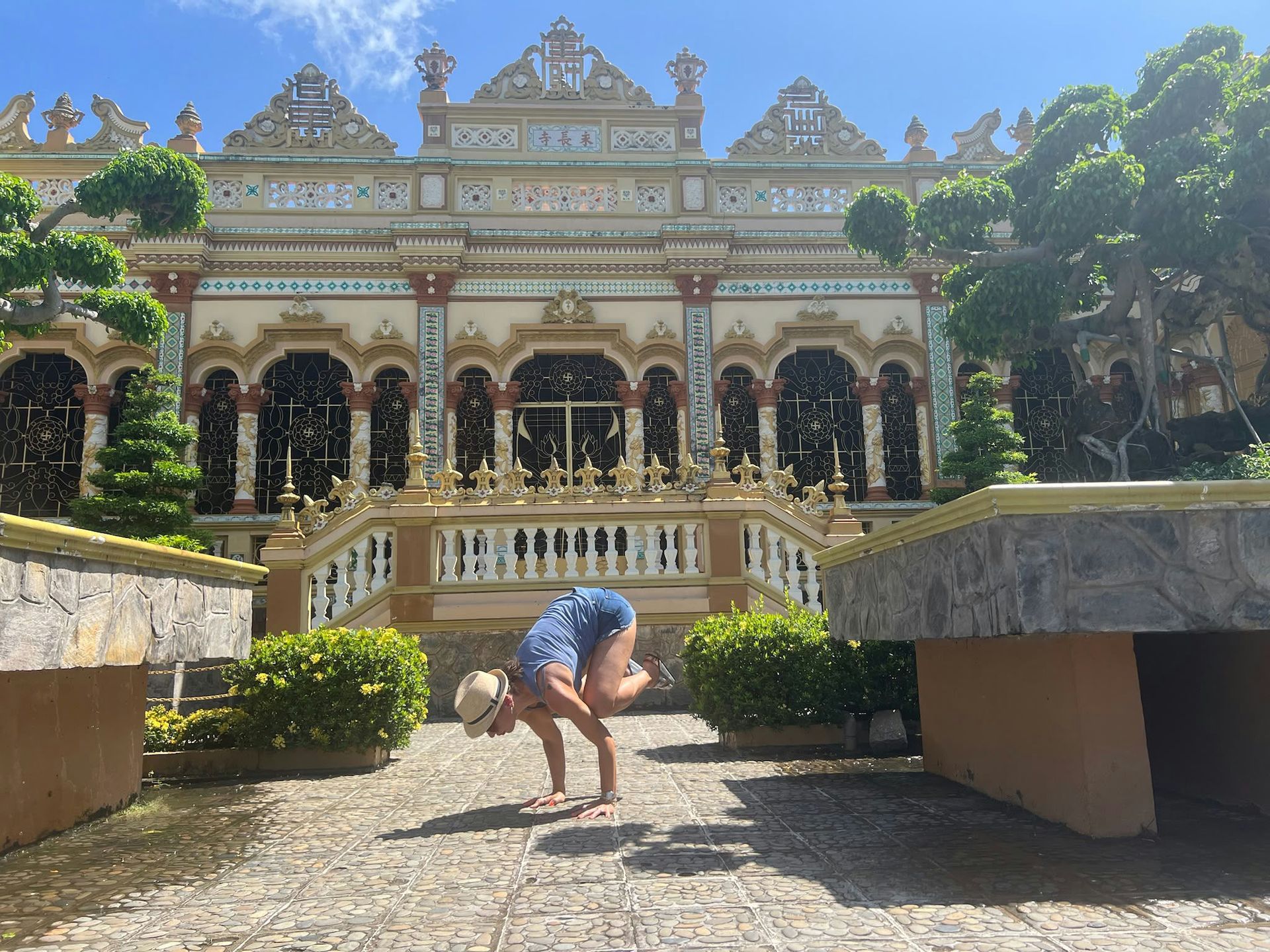
Your hands are rooted to the earth. Your knees push into your armpits. You lean forward, perhaps a little further than feels comfortable, and suddenly there is a fleeting, almost magical moment when your feet leave the ground.
You are flying.
And then, quite often, you fall.
Perhaps you laugh. Perhaps you feel frustrated. Perhaps you trust yourself to immediately try again. And perhaps this trust is the whole point.
As well as being an arm balance - a physical achievement requiring strength, balance and technique - there is something else happening in Crow Pose that is much more interesting:
At some point, strength alone isn’t enough. You have to trust. You have to lean beyond the place where your mind tells you it is safe to go.
We spend so much of our lives trying to remain on solid ground. We like certainty. We like to know what comes next. We like guarantees. But yoga continually invites us into a different relationship with uncertainty.
The Sanskrit word abhyāsa is often translated as practice or persistent effort. In the Yoga Sūtras, Patañjali places it alongside vairāgya - non-attachment, or the ability to let go of our insistence on a particular outcome.
Practice and let go. Try and release. Show up, but don’t cling to the result. What resonates for me here is a beautiful teaching from the Bhagavad Gitā: “You have a right to your labour, but not to the fruits of your labour.” ((कर्मण्येवाधिकारस्ते मा फलेषु कदाचन. मा कर्मफलहेतुर्भूर्मा ते सङ्गोऽस्त्वकर्मणि ॥४७॥) ~2.47
Yoga arm balances help us embody this teaching beautifully: we can understand the mechanics. We can watch someone else demonstrate it. We can read about where our drishti should go and how to distribute our weight. But eventually, we have to do something much more vulnerable:
We have to trust and try.
We have to shift our centre of gravity, allow our feet to become lighter, trust our hands to hold us, and perhaps most importantly, we have to accept that we might fall.
This is one of yoga’s quieter teachings: falling isn’t failure.
Sometimes falling is important information: our bodies, nervous systems and minds learn that the thing we feared was survivable. And slowly, almost imperceptibly, the boundary of what feels possible begins to move. We start asking ourselves:
“What would happen if I trusted myself enough to leave the ground?”
Where in life is holding you back because you don’t know what will happen next? Why are you waiting to feel completely ready before you begin? Will this moment ever come or do you have to create it yourself? Where are you gripping tightly to certainty when perhaps what is being asked of you is a little more surrender?
We don’t have to be fearless. Courage has very little to do with fearlessness. Instead it is about is feeling the fear and leaning forward anyway.
Arm balances are humbling. We either find the balance or we don’t. And learn that there is no judgement in the pose itself. The earth doesn’t care whether we fall. Our mats don’t care. Our practice doesn’t care. It’s all ego.
We inevitably gain wisdom as we repeatedly push our egos aside, place our hands back down and begin again.
This is abhyāsa.
Not perfection. Not achievement. Just returning. Again and again.
The ancient yogis understood that transformation rarely happens in one dramatic moment. It happens through repetition. Through returning. Through staying with something long enough for the relationship with it to change.
Perhaps the first time you practise Bakasana, you are convinced you’ll never do it. Then one day, one foot lifts. Then both - maybe only for a breath, but something has changed in your understanding of yourself. You now know that something you once believed to be impossible has become possible.
And that knowledge travels beyond the mat - this is why the physical practice of yoga can be such a powerful mirror for our lives. The pose becomes a small laboratory for being human.
We practise falling, knowing it’s not failure but growth. We dust ourselves off and try again and again. Repeatedly. We practise trusting our own strength. We practise surrendering the need to control the outcome. We practise returning to the pose, and right there, whether we know it or not, we’re embodying yogic philosophy.
Yoga Sūtra 1.14, Patañjali:
“Practice becomes firmly rooted when it is cultivated for a long time, without interruption and with devotion.” (स तु दीर्घकालनैरन्तर्यसत्कारासेवितो दृढभूमिः ॥ १४ ॥)
We learn that, in our practice, we have to trust. To fall. To let go of needing the outcome to be different from what it is.
To summarise the lesson: don’t worry too much about whether your feet leave the floor. Notice what happens when you lean forwards. Notice the stories your mind tells you. Notice the moment fear appears. Notice what happens when you breathe through it.
And if you fall? Either on or off the mat?
Smile, place your hands back on the earth and begin again.
The real challenge is the consistency that teaches us we can fall and rise again. Like a phoenix. We can trust ourselves and the resilience we possess within.